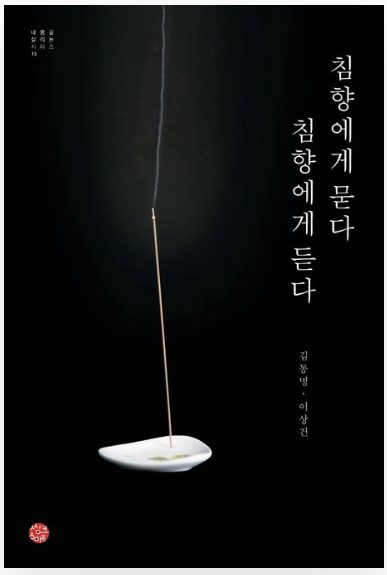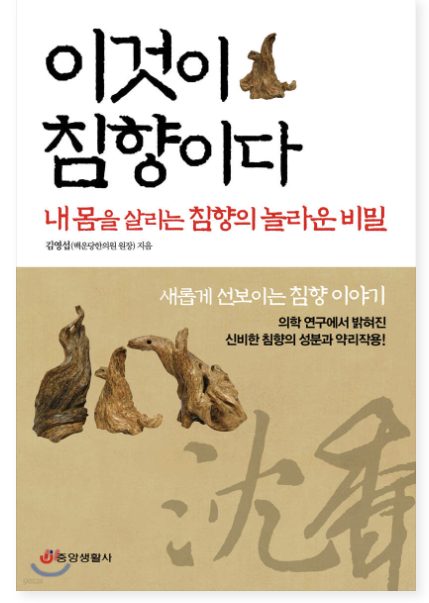
This Is Agarwood (in Korean)
- Published
- October 10, 2020
- Pages
- 208
- ISBN
- 9788961412575
A verse celebrating ten virtues of incense. It is traditionally attributed to the Northern Song poet Huang Tingjian (黃庭堅) and has long been recited in the incense cultures of China, Korea and Japan.
Incense reaches the divine; even spirits respond to it.
It leaves body and mind clear and clean.
It clears away filth and stale air.
It rouses one from drowsiness and brings alertness.
In quiet moments, it becomes a companion.
It offers a moment of ease in a busy world.
Even in abundance, it never wearies.
Even a small amount is ample.
Stored for a long time, it does not decay.
It may be used every day without hindrance.
Incense has been part of human life since ancient times. People burned natural incense to purify a space, to scent clothing and bedding, and to keep insects away. They also carried it on the body in sachets.
Among all incense, agarwood was counted the incense of incense, but it was so rare and costly that only a few connoisseurs could enjoy it. For the same reason it was hard to tell genuine from false, and even today it is important to check the origin and species carefully when choosing agarwood.
| Method | Description |
|---|---|
| Heated incense (薰香) | A piece of agarwood is placed on charcoal or an electric burner and warmed gently |
| Stick incense (線香) | Powder is kneaded into thin sticks, which are lit and burned |
| Scenting clothes (薰衣) | Clothing and bedding are held in incense smoke to take on its scent |
| Sachets (香囊) | Incense is placed in a small pouch and carried on the body |
| Offerings (供養) | Incense is offered to the Buddha and the gods at temples and in rituals |