The genus Aquilaria
Agarwood comes from evergreen trees of the genus Aquilaria in the family Thymelaeaceae. Several species in this genus are distributed across Southeast and South Asia, southern China and New Guinea, and the aromatic resin they produce is collectively called agarwood.
Even under the single name "agarwood," origin, fragrance and permitted uses in Korea vary by species. That is why checking the scientific name matters.
| Scientific name | Main range |
|---|---|
| A. agallocha | Cambodia, Malaysia, Thailand, Laos, Vietnam |
| A. malaccensis | Indonesia, Malaysia, Laos, Thailand, India |
| A. crassna | Cambodia, Malaysia, Thailand, Laos, Vietnam |
| A. sinensis | China, Laos |
| A. banaensae | Vietnam |
| A. subintegra | Thailand, Cambodia |
| A. baillonii | Cambodia, Thailand |
| A. khasiana | Bangladesh, India |
| A. hirta | Thailand, Indonesia, Malaysia |
| A. microcarpa | Indonesia, Malaysia |
| A. beccariana | Indonesia |
| A. cumingiana | Indonesia, Malaysia |
| A. filaria | New Guinea, the Moluccas, Mindanao (Philippines) |
| A. acuminata | Papua New Guinea, Indonesia, Philippines |
| A. apiculata | Philippines |
| A. brachyantha | Malaysia |
| A. rostrata | Malaysia |
| A. grandiflora | China |
Scientific names listed in Korean standards
Agarwood as a food ingredient
In the Korean Food Code's list of "raw materials permitted for use in food," agarwood is listed under the following two scientific names.
- Name
- Agarwood tree (agarwood)
- Scientific name
- Aquilaria agallocha Roxburgh
Aquilaria malaccensis Lam. - Part used
- Trunk wood with deposited resin
Agarwood as a pharmaceutical raw material
The Korean Herbal Pharmacopoeia defines agarwood (沈香, AQUILARIAE LIGNUM) as follows.
- Origin
- Trunk wood with deposited resin from the agarwood tree, Aquilaria agallocha Roxburgh (Thymelaeaceae)
- Other names
- Chimsuhyang (沈水香), aloes wood
- Description
- Blackish brown, with parallel fibers holding resin. Gives off a distinctive fragrance when burned; bitter in taste
Agarwood specifications in the Korean Herbal Pharmacopoeia
| Item | Standard |
|---|---|
| Heavy metals | Lead ≤ 5 ppm · arsenic ≤ 3 ppm · mercury ≤ 0.2 ppm · cadmium ≤ 0.3 ppm |
| Loss on drying | ≤ 8.0% |
| Ash | ≤ 2.0% |
| Extract content | Dilute ethanol extract ≥ 18.0% |
| Grade | Acceptable quality |
Sources: MFDS, Korean Food Code; The Korean Herbal Pharmacopoeia, agarwood (KFDA Notice No. 2011-26 and others)
The species on Daeracheon's farms
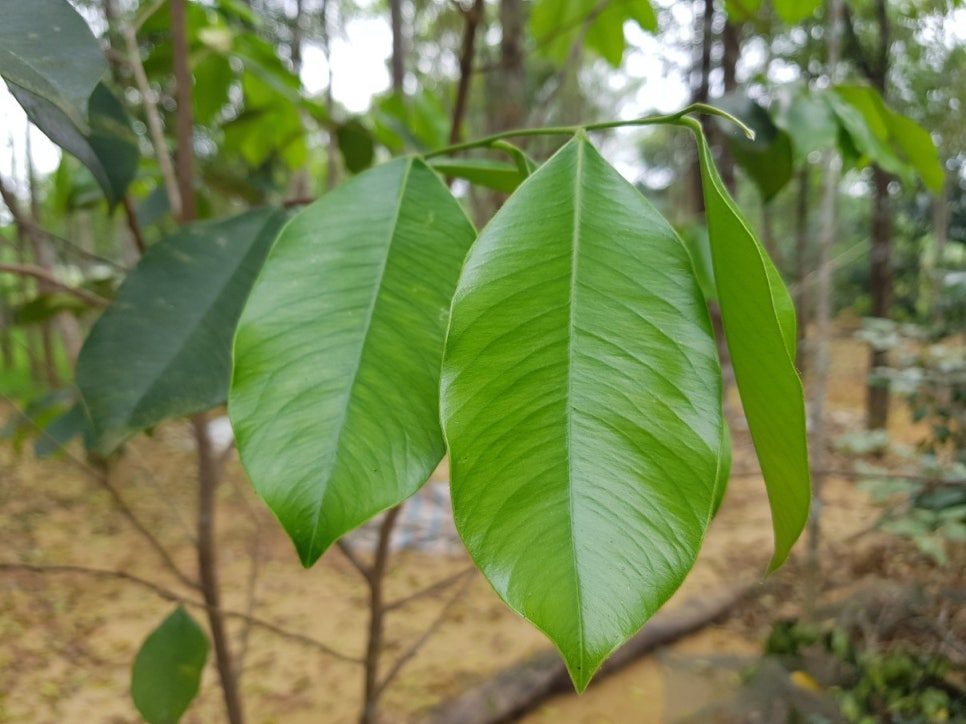
Daeracheon's farms in Ha Tinh and Dong Nai grow a single species, managed as Aquilaria agallocha Roxb., the scientific name listed in both the Korean Food Code and the Korean Herbal Pharmacopoeia.
Vietnam has long been a major source of agarwood. The National Institute of Korean History's Hanguksa (History of Korea) states that the agarwood favored by Silla aristocrats was produced mainly in Champa (占城國, present-day central Vietnam) and Sumatra.
The debate over scientific names
The scientific name of agarwood is still debated among scholars. The Plant List, CITES and the IUCN treat A. agallocha as a synonym (異名) of A. malaccensis.
Kim In-rak (2013) compared historical texts, national pharmacopoeias and the places where each species was first described. He concluded that the agarwood traditionally used is closest to Vietnam's A. crassna, and proposed reexamining the scientific name in the Korean Herbal Pharmacopoeia.
The scientific names on this page reflect what is listed in Korea's Food Code and Herbal Pharmacopoeia.
Reference: Kim In-rak, "The scientific name of agarwood (沈香) based on the distribution map of Aquilaria species," Korean Journal of Herbology, 2013. Full text (in Korean)